 Blog Home
AI-first is not vibe coding
Our last post explained why Intent Yield exists: a Lighthouse for shopper intent. It’s one score for how well a brand captures, engages, and converts intent, benchmarked against the leaders in its category. This post explains how we built it, and why you can trust the number.
Our most recent articles
Our last post explained why Intent Yield exists: a Lighthouse for shopper intent. It’s one score for how well a brand captures, engages, and converts intent, benchmarked against the leaders in its category. This post explains how we built it, and why you can trust the number.
Intent Yield was our first live proof of how AI is changing the way we build, and it became the blueprint for our new development process. AI didn't replace our ecommerce expertise. It amplified it. We brought years of experience to the vision and user context, while AI helped us define the problem, specify the solution, write the code, and test every edge case.
A model can build something in a weekend, and it often gets demoed before anyone checks how it holds up at scale. Intent Yield is a scoreboard. Brands are going to quote its number back to us and act on it. So our bar is higher than "does it produce something?" It is "Is it accurate? Can we tell when it is not? Will it hold up to scrutiny? How fast can we fix it if we encounter issues?"
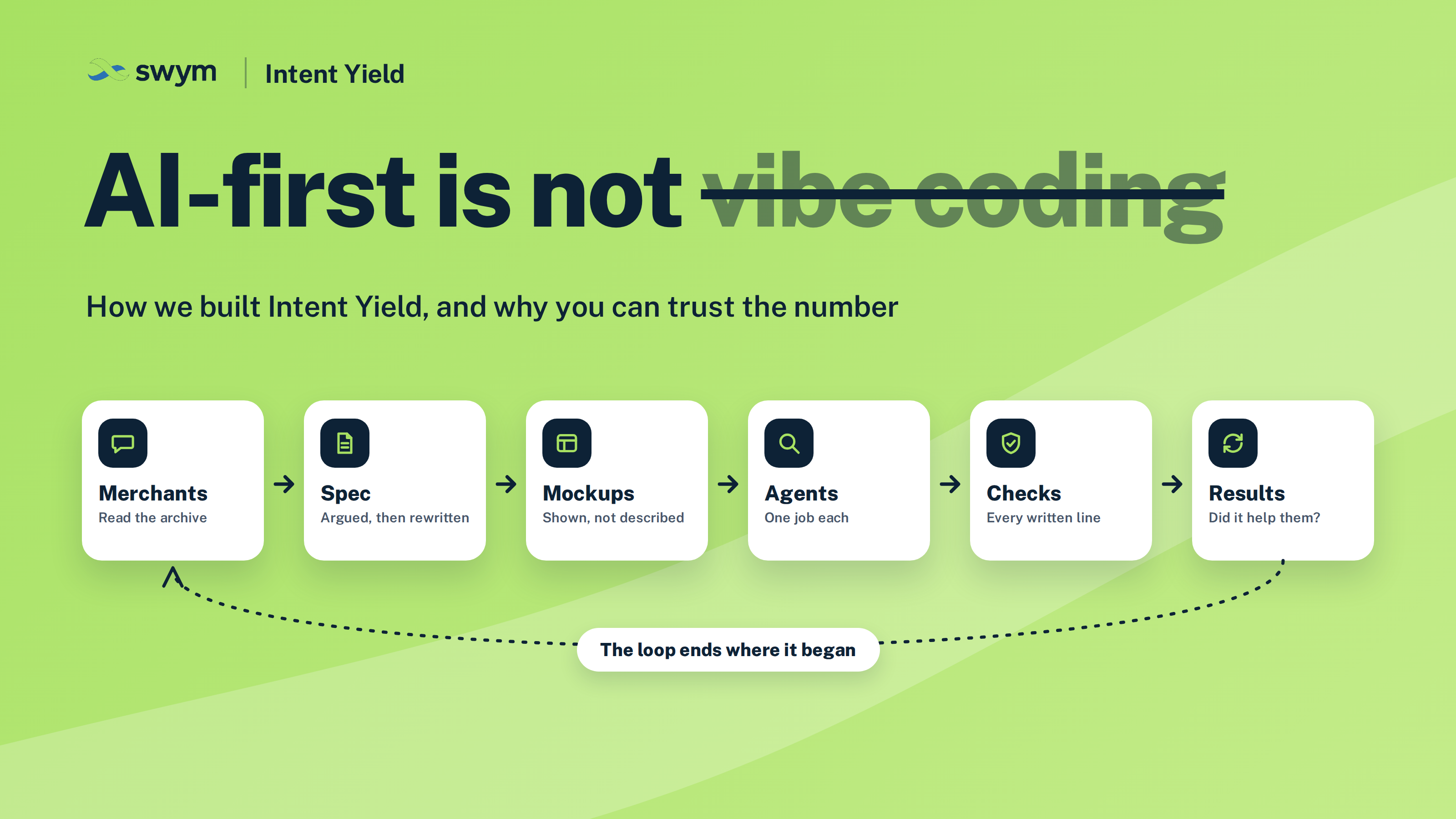
What changed at Swym is that the whole loop now runs on one system. It starts with a sentence a merchant typed into a support chat two years ago, and ends with whether the thing we shipped worked for them. Code generation is one step in the middle, and it’s the easy one.
It starts with what merchants already told us
We don’t start a spec with a blank page or a strong opinion. We start with the archive.
We are also not reading it cold. Swym has spent years studying the moments when a shopper shows intent but doesn't buy yet. We know where those moments break:
- Saving a product to come back to (the save option is missing or hidden)
- Waiting for a size to be restocked (the restock alert never gets offered)
- Sharing a shortlist with someone else (the list doesn’t follow the shopper)
- Returning on another device and finding their picks gone (the brand never hears about the intent)
That map of shopper friction is what we read the archive against.
Years of support conversations, chats, and tickets are the most honest record of what merchants struggle with. Almost none of it gets read. No team can hold thousands of conversations in their heads and notice the same frustration described 40 different ways.
A model can. Step one is reading across all of it and surfacing the patterns: what merchants ask for, where they get stuck, which workarounds keep appearing, and what they call things. We use their language, not ours. A theme that appears in 40 threads from 30 stores is a fact about the market. A theme one person mentioned twice is a story we’d have told ourselves.
That becomes a ledger of candidate problems, each linked to the sentences it came from. When we debate priority, we debate real quotes.
Before anything gets specced, an idea is stress-tested against merchant perspectives built to disagree with each other and with us. Most ideas don’t survive, which is the point. Losing an argument with a simulated apparel merchant costs far less than losing it with a real one after launch. Intent Yield went through the same test. The longest debate was whether the score should help brands that never use Swym. The answer shaped the whole product.
AI drafts the spec too. The we argue with it and rewrite it until the intent is clear. That raised the bar for the human role. We decide whether the spec is right, whether this is a problem worth solving, and whether the edge case being waved away is the one that ends up defining the feature.
We also stopped describing the end state and started showing it. Alongside the spec, AI produces working mockups of the actual experience: the report, the score, the empty states, and what a brand gets on a bad scan as well as a good one. Mockups used to cost so much that they arrived after the decision was made. Now they arrive with it, and more people can take part. Six people can sign off on a written spec while each pictures a different product, and nobody finds out until weeks later. A screen doesn’t leave that room for misreading.
AI proposes, and a human decides. Deciding takes taste and accountability, and the model has neither.
Built with agents, not prompts
We run agents. A prompt is text in, text out. An agent has one job, a narrow brief, and its own tools. Ours open real browsers, search the web, and read our own data.
We started with one agent doing everything. When it got something wrong, we couldn’t tell which part failed. Real storefronts, with hidden buttons and slow-loading pages, made that unworkable. So we split the work into small jobs, each done by an agent that only reports what it has evidence for. A tightly scoped agent with the right evidence beats a smarter one juggling the whole problem.
The score itself isn’t generated by AI. A fixed rubric calculates it from the evidence, so the same store gets the same number every time. The models only write the explanation.
Adversarial agents and verification
Two of our agents exist only to catch mistakes.
One first reviews the browser agent's findings before anything is scored. Its job is to disagree. Using the same evidence, it tries to prove that the surface we claimed we found is not really there
The other came out of a gap we shipped. We were verifying the findings, then generating the report text from them, and shipping the prose unchecked. A report could be internally correct and still contradict itself between the headline and the third paragraph. Nothing caught it, because nothing was reading the finished report.
That turned out to be our method rather than a detail. Every place we let a model write something, a fixed check reviews it afterwards.
Getting better with every scan
Every scan leaves a record of what each agent found, where agents disagreed, what a reviewer corrected, and where confidence was low. Added across many scans, those records show us where the product is weakest, based on evidence.
Our backlog comes from reading thousands of runs and grouping the friction we most often miss, weighted by what it costs the merchant.
Each of these is a moment of shopper intent the scan has to catch, and the runs tell us which ones we are still missing:
- A wishlist hidden behind a hover state
- A back-in-stock form that only appears after a size is picked
- A save button that loads after the shopper has already scrolled past
AI reads the run and proposes the order. A human decides whether the order is right, because the most frequent issue isn’t always the most important. Only a person can judge what a wrong answer costs a specific brand.
When we confirm a miss, someone corrects it once. A reviewer can promote that correction into a rule for every future scan. One person noticing a repeat mistake fixes it for every store we scan afterwards. No retraining, and no new model.
Then the loop closes where it began. The conversations that produced the spec are still there, and the merchants in them are real. We finish a piece of work by asking whether their problem got better and whether we can prove it. That’s a harder question than “Did we ship it?”, and we won’t always like the answer. That’s why it belongs at the end of the loop.
Your data stays yours
Benchmarks make Intent Yield useful, and they exist because we work across the whole Swym network. That’s why we treat privacy as an engineering problem rather than a policy page.
A scan of any store uses only what any shopper can access on the public storefront. Nothing private is involved, because nothing private is available. Aggregate insight is worth a great deal to every brand in the network. Each brand's own data belongs to that brand, and none of it should be traceable from anything we publish. The score the category leaders the same way, from public scans of their storefronts, never from data a brand shares with us.
Scanning a storefront is the easy half. The difficulty is knowing what you’re looking at. Is a restock form gated behind a size selector a deliberate choice or a broken funnel? Is a wishlist behind a hover state a clean design or a capture leak? What does a well-run apparel storefront do at these moments that a well-run furniture store doesn’t, and why are both right? That judgment isn’t on the page. It comes from years of running these exact surfaces, (save, restock alerts, shared lists, cross-device return) on real storefronts, and learning which patterns convert intent and which only look tidy.
That experience is what we encoded into the rubric. The rubric carries the lesson without carrying anyone’s data. Each brand's records stay with that brand. What the network contributes is a calibrated sense of what good looks like in each category, applied to storefronts anyone can visit. The benchmark is credible because of what we’ve learned, and confidential because of the data we never move.
No install, no account, no catch
The last principle is the one we stress-tested hardest before committing to it, and it’s the one we’d defend first.
You don’t need to be a Swym customer to get a score. You don’t need any specific platform, install anything, create an account, or talk to us. The scan runs on your public storefront, and the report tells you everything we found, including the parts that have nothing to do with what we sell.
When a fix maps to a Swym product, we say so once, plainly. When it doesn’t, we still tell you, and we point to the tools you already use.
That was a deliberate choice, and an easy one. A benchmark that only measured our own customers would be marketing with a number attached. Sharing the diagnosis with brands who may never buy from us costs us nothing. What matters is the judgment behind the number: which intent moments matter in a given category, what the leaders actually do about them, and what the gap costs a brand that ignores them. That took years to build, and withholding a report wouldn’t protect it. Commerce is better off when every brand can measure this gap, and we’d rather be the ones who explain it. If the score helps, the relationship follows.
The system matters more than the model
The split is simple. AI is extremely good at building things. It has no opinion about whether something should exist, what it’s allowed to claim, or who it should help.
Models will keep getting better, and that will change less than people expect. Anyone can rent a model. The advantage comes from the system around it: merchant feedback we read rather than remember, work split into jobs small enough to do well, checks that catch a confident model being wrong, corrections that become rules, and a loop that ends by asking whether any of it helped.
The post before this one made the case for a Lighthouse for shopper intent, and why the gap between wanting and buying deserves a number at all. This one is the answer to the question that comes right after it: why you can trust that number when you see it..
Here’s what you take away. You get a clear read on where shoppers are showing intent on your storefront and where you are quietly losing it. It’s measured against the leaders in your category, written in language you already use, and ordered by what each fix is worth to you. No install, no account, no sales call. Your shoppers are already telling you what they want. Intent Yield turns it into something you can act on tomorrow morning.
Capture the Products your Shoppers Truly Love
Swym Wishlist Plus lets shoppers save products they love, ensuring valuable customer intent is never lost and ready to convert.

.webp)