 Blog Home
The most important number in commerce doesn’t exist yet
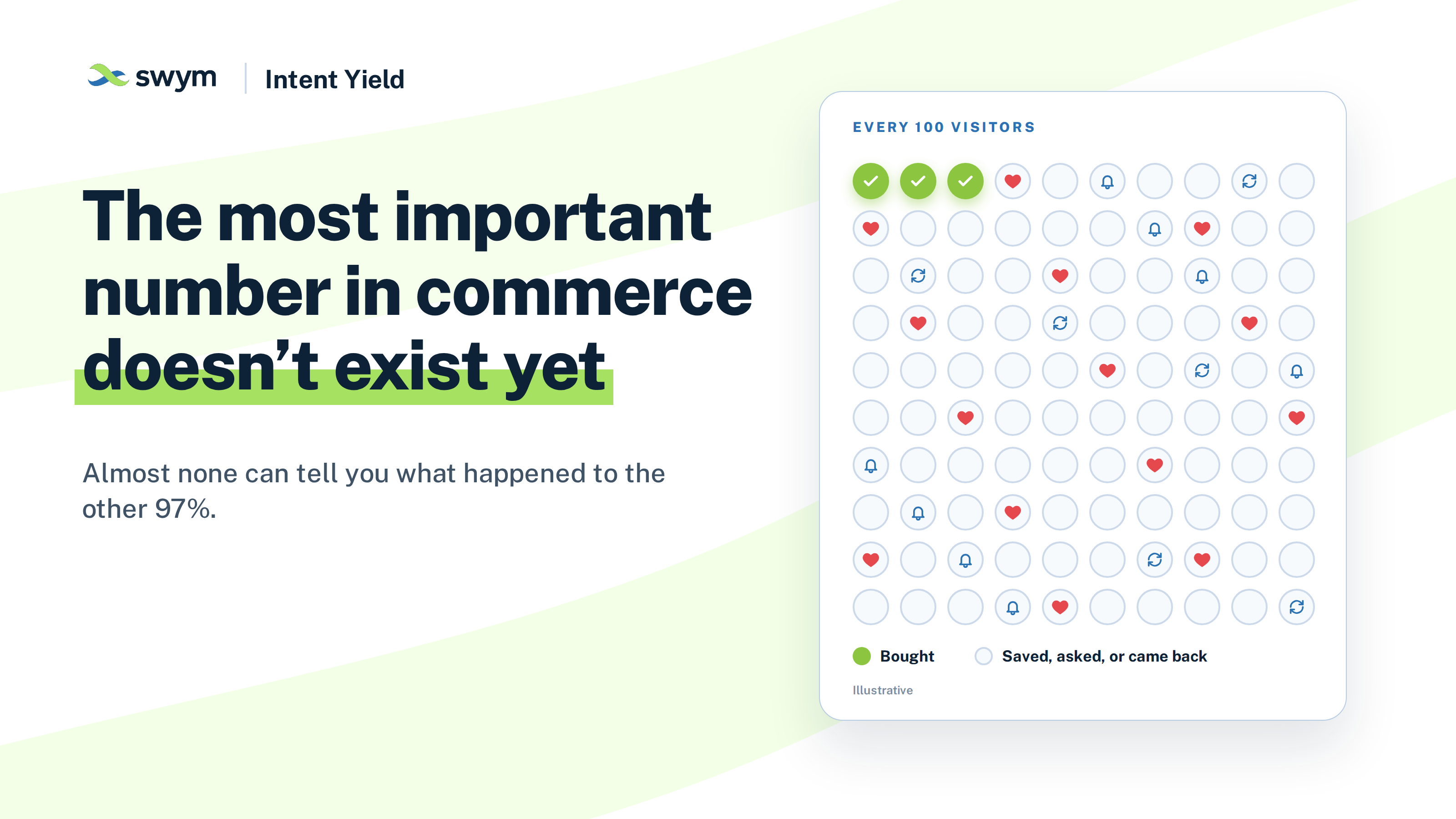
Every brand can tell you their conversion rate: 2%, maybe 3%. Almost none can tell you what happened to the other 97%. For a decade we've treated those shoppers as lost. They're not.
Our most recent articles
Every brand can tell you their conversion rate: 2%, maybe 3%. Almost none can tell you what happened to the other 97%.
For a decade we've treated those shoppers as lost. They're not.
They saved the item. They asked for a restock alert. They came back three times. That isn't “lost” demand. That’s demand that told you exactly what it wants, then waited for you to act. Across the tens of thousands of merchants we work with, that declared intent is the richest signal in commerce. And most of it goes unused, because acting on it is manual, fragmented, and never finished.
This is the problem we set out to solve: you can't manage what you can't measure, and this has never been measured.
We measure everything else. Site speed has a score. SEO has a score. Ad accounts have a dozen. The question "how well does this brand turn intent into revenue?" has no score at all.
Yet that question decides whether that 97% ever comes back. Without a number, you can't improve it, benchmark it, or hold anything accountable for it. It stays a gut feeling, chased with disconnected tactics: an email here, a retargeting campaign there, no scoreboard tying them together.
So we built the scoreboard.
The closest comparison is Google Lighthouse. Before Lighthouse, "is my site fast?" was an argument. Lighthouse turned it into a 0–100 score across clear dimensions, and it told you what to fix. It became the shared language for web quality almost overnight, because a good score was suddenly something you could track, compare, and chase.
Intent Yield does the same for the commerce question that actually moves revenue: how well do you capture intent, engage that intent, and convert it to sales? One score, three stages, and the dollars still on the table. One key difference from Lighthouse: we score a revenue outcome, beyond technical hygiene.
A score on its own tells you little. Benchmarks matter as much as the number. A score becomes useful the moment it's relative. “You’re at 62” is a fact. “Brands like you reach 80” is a goal. This gap is winnable, not theoretical.
Two things make those benchmarks credible. First, they're empirical, drawn from aggregated, anonymized intent-and-outcome data across our whole network. Second, they're category-relative. Intent behaves differently across categories: apparel runs on restocks and sizes, electronics on considered price drops, beauty on replenishment. A universal benchmark would mislead you. So we measure you against the leaders in your category, the brands who sell what you sell and demonstrate what "great" actually looks like. That's what makes the gap real and achievable. And only someone with years of cross-merchant intent data can set that bar.
Then we go where Lighthouse stops. Lighthouse tells you what's wrong. We help you act on it . We size each opportunity in real dollars and make the fix easy to run, through the tools you already use wherever possible. We continue to invest in shortening the distance between insight and action, automating more of that work over time, because your revenue is the goal. One principle won't change: nothing runs without your approval, and every recommendation shows its math.
Why this matters beyond a feature:
For years, commerce software sold features and left the outcome to you. The next decade belongs to software that's accountable for the outcome – and can prove it. A score makes the outcome legible. Benchmarks make it honest. Acting on it makes it real. That's what turns a wishlist into a foundation, and an app into a platform.
This is the first step. We're going to meet brands exactly where they are, and help them climb all the way up.
None of this used to be measurable. Now it is! And once the gap has a number, you can't ignore what you're leaving on the table.
P.S. Our launch note breaks down exactly what the score measures. Our Product lead for Wishlist Plus, Sakshi Gupta, will follow with a companion post on how we built it, and why it was AI-first from day one.
Capture the Products your Shoppers Truly Love
Swym Wishlist Plus lets shoppers save products they love, ensuring valuable customer intent is never lost and ready to convert.