Blog Home
Intent leakage: what it is and how to stop it
Most shoppers who leave weren't saying no. Here's how to find the intent your store isn't recording, and what to do about it.
Our most recent articles
Shoppers tell you what they want before they leave. Here’s how to record it and bring them back.
Your store already attracts shoppers who know what they want, and those shoppers show their interest in small ways all the time. They return to the same product, check a size, or wish a sold-out item would come back. Record those moments, and each one becomes a reason to bring a shopper back.
We call this gap intent leakage: shopper intent your store generates and never records or acts on. Most stores leak intent, but the ones that close the gap get ahead.
In this guide, you'll learn where intent shows up, how to capture it, and how one company turned it into 20% of its revenue.
Every visit holds more than a sale
Most visits don't end in a purchase, and that's normal. Swym data shows only 2 to 4 percent of visits end in a sale. That means 96%+ of shoppers are still deciding.
Deciding isn’t the same as leaving for good. Picture one shopper on one visit to your store. They show you what they want four times, and at each moment your store either records that intent or leaks it:
- Browsing: two products catch their eye. Your store can record both.
- Considering: they open one product page three times across two devices. That’s repeat interest, and your store can capture it.
- Wanting: their size is sold out, and they’d like a way to ask for it. A back-in-stock alert turns that moment into a future sale.
- Leaving: they leave the site to think it over. What your store recorded decides whether you can bring them back.
Each moment is a chance to record what they want and bring them back to it. That shopper told you what they wanted at least four times. Your store can be ready to catch every one.
Shoppers research before they buy, and that gives your store time to capture their intent
Shoppers rarely buy on impulse. Swym data puts the average time from first intent signal to purchase at 41 days, across 6 to 8 touchpoints on different devices.
For your store, that’s 41 days of chances to capture intent, and 41 days where it can leak. Every repeat view, save, and sold-out size is a signal. Record them, and you’ll be there when shoppers are ready to buy.
Last-click attribution credits only the final visit before a purchase. It misses the weeks of consideration that came first, so it hides the intent you captured and the intent you leaked. Measuring the full window shows what your store already earns.
When a shopper saves a product or asks for an alert, they’re telling you their plan. That record belongs to you, so every signal your store captures is one you can act on.
3 links turn interest into revenue: capture, engage, convert
Think of intent as a chain with three links. Capture the interest, engage with relevance, and convert with timing.
Capture
Record what the shopper wanted. That includes saves at the exact size and color, repeat views without a cart, and searches for sold-out items.
Engage
Reach out when the answer changes. Send back-in-stock alerts on the exact variant, price-drop alerts on saved items, and saved-for-you emails inside the flows you already run.
Convert
Prove the signal turned into revenue. Track each alert from send to purchase, so you know what every signal earned.
How to turn intent into revenue: 5 steps
1. Let shoppers save without an account
Guest capture lets browsers save favorites or sign up for alerts without a password. Fewer hurdles means more signals. Each one is first-party data you can use for personalized outreach later.
Try this today: save a product as a first-time visitor and note whether your store asks you to log in.
2. Give sold-out items a next step
A sold-out badge doesn't have to be a dead end. According to Swym data, the median revenue per back-in-stock alert is $63. Add alerts to collection pages as well as product pages, so shoppers can ask without clicking in first.
Try this today: find a sold-out product on a collection page and check whether shoppers can request a restock alert without leaving the page.
3. Add price-drop alerts on saved items
The shopper already wanted the product. When the price drops, the nudge feels welcome, not pushy. It also protects your margins, because you aren't discounting your whole store.
Try this today: save an item and check whether anything reaches you when its price changes.
4. Capture intent without a click
Not every interested shopper taps “save.” Swym's Smart Save turns repeat views into saves automatically, so quiet interest gets recorded too.
Try this today: ask your team what your store records when a shopper views the same product three times.
5. Keep the signal with the shopper
Sync saves across phone, laptop, and store, so a shopper never starts from zero. Then send the signal to the email platform you already run, such as Klaviyo or Attentive, so your flows can act on it.
Try this today: save an item on your phone, then open your store on a laptop.
Case study: how TOV Furniture turned interest into 20% of revenue
TOV Furniture sells bright, fashionable pieces that do well on social media. Furniture is a big purchase, so shoppers explore and compare before they decide. TOV had strong traffic and plenty of interest, and Black Friday was approaching. The team wanted to be ready.
They captured intent with Swym, then activated it through Klaviyo workflows: wishlist reminders, back-in-stock alerts, and price-drop alerts. The results, from TOV's case study:
- 4.6x higher conversion for wishlist users than non-wishlist users.
- 20% of revenue attributed to Swym
- 600x lifetime ROI
- $19.39 in revenue per wishlist reminder email
- In 30 days, captured intent actions grew 127%, and automated alerts sent grew 5.1x month over month
- 4.2x higher average order value on the B2B store
TOV’s Product Manager put it this way: "Swym became a simple way to bring back our customers to buy, without overcomplicating our tech stack."
The takeaway: TOV's biggest growth opportunity was converting shoppers who already showed interest.
Find out what your store is already capturing
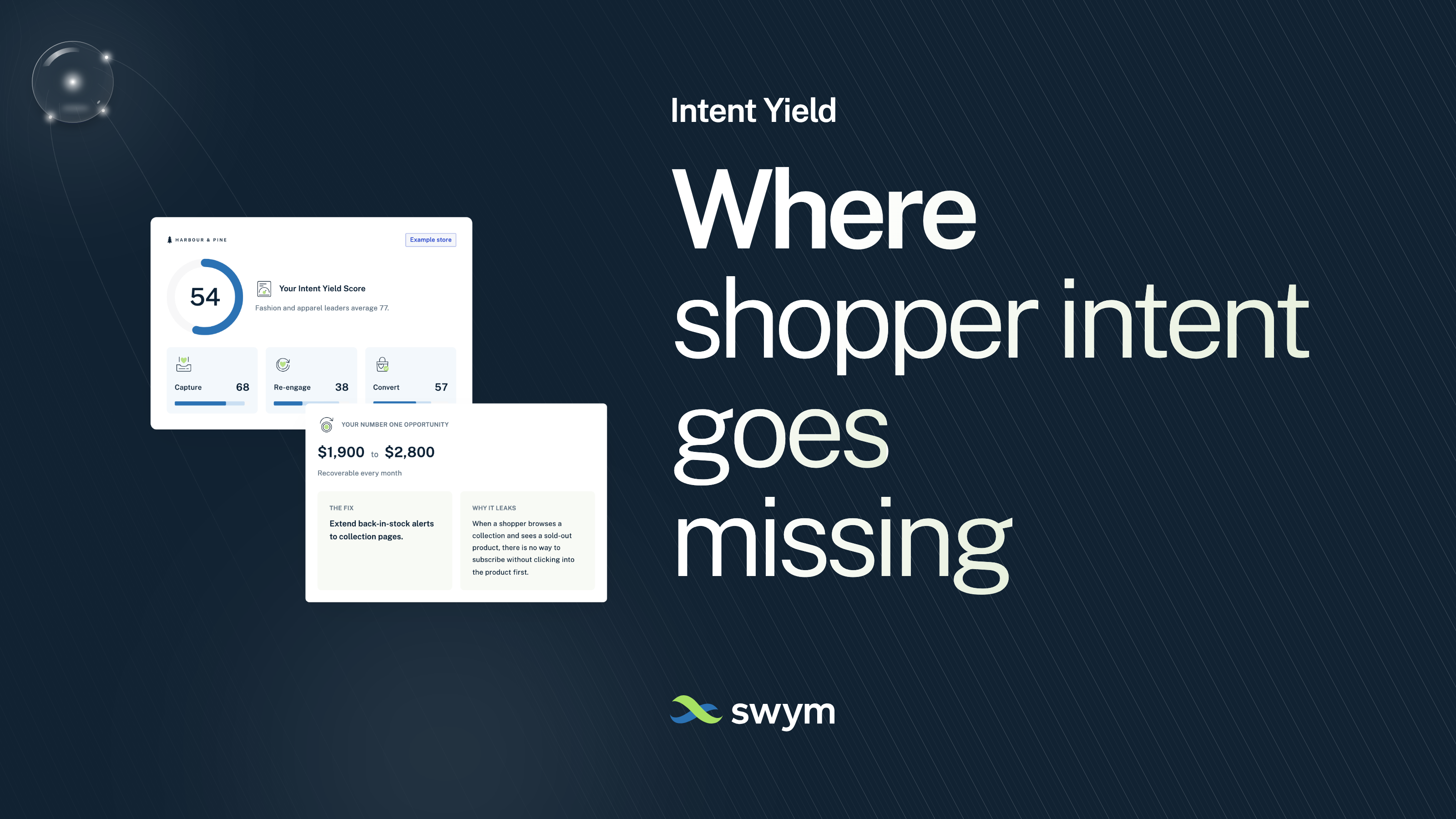
Intent Yield is how much of a store's shopper intent turns into sales. The Intent Yield Score puts a number on it.
It's a free, read-only scan of your public storefront. Results take about 30 seconds, with no install, no code, and no theme change. Swym never asks for admin access.
The scan checks your store from three shopper views: a first-time visitor, a returning shopper, and someone on mobile. It covers every page from home through checkout entry. You get your score and your biggest opportunity, with an estimate of what it's worth. The benchmark is drawn from 1B+ captured intent actions.
Frozen until January? You can measure now and act when the freeze lifts.
Capture the Products your Shoppers Truly Love
Swym Wishlist Plus lets shoppers save products they love, ensuring valuable customer intent is never lost and ready to convert.