Blog Home
Intent Yield: score how well your store turns traffic into revenue
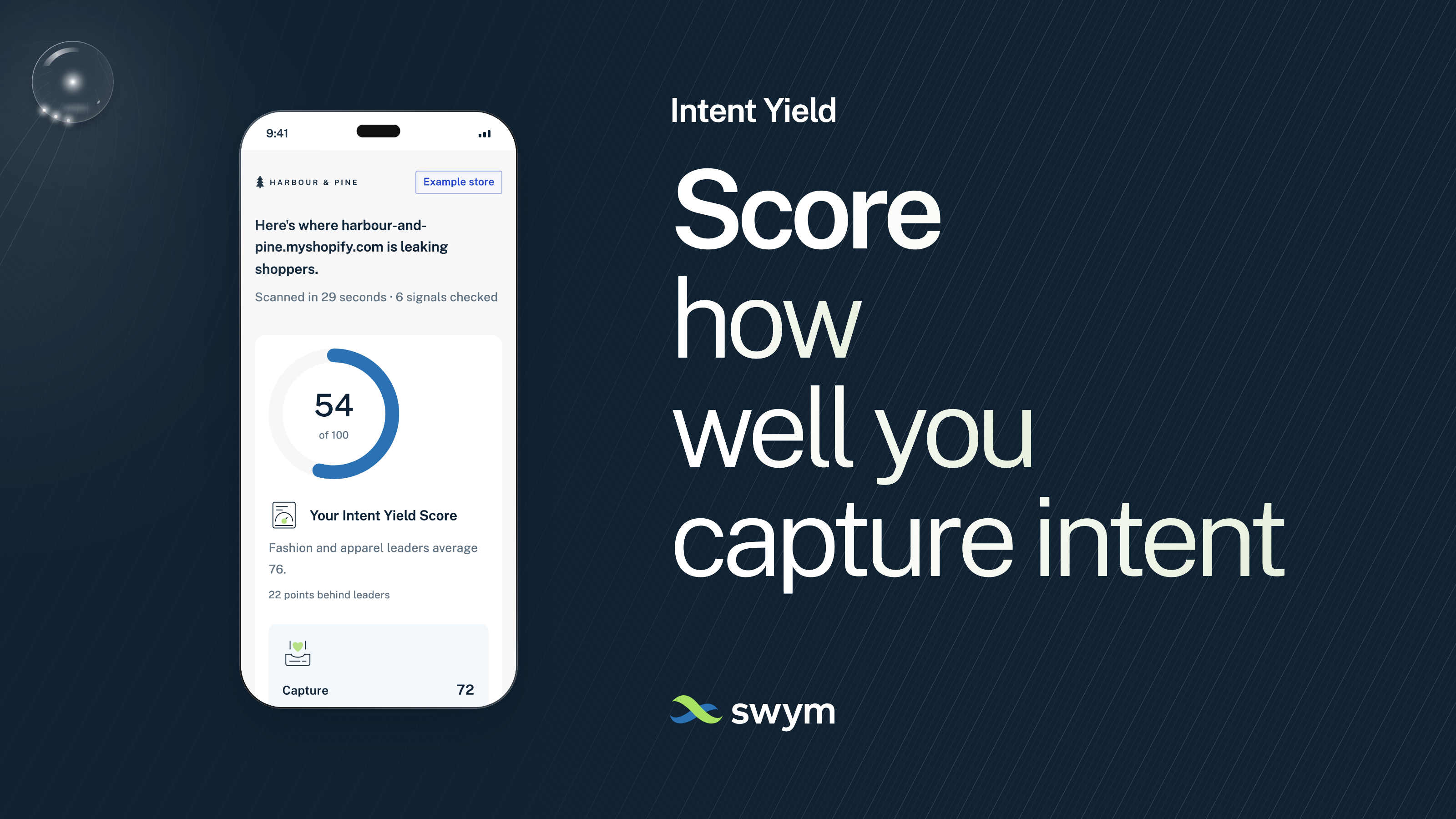
A free, no-install audit that scores how well your store captures, engages, and converts shopper intent, benchmarked against top stores in your category.
Our most recent articles
IN SHORT
- Intent Yield is a fast, free, no-install audit that scores how well your store captures, engages, and converts shopper intent.
- The scan reads the public storefront only. The score lands on screen in about 30 seconds, and the full report follows by email.
- Every report returns three stage grades, the biggest gap, and what closing it is worth.
- Agencies can run it across every client store they manage.
Where shopper intent slips away
Only 2 to 4% of shoppers buy on a visit. The other 96%+ leave, and most stores record nothing about what they wanted.
Take one shopper on one visit. They browse a collection, and two products catch their interest. They open one product page three times, across two devices. Their size is sold out, and there's no way to ask for it. Then they leave, and paid ads start the work of bringing them back.
That shopper expressed interest at least four times. The store recorded none of it.
Until now, intent leakage had no number. Google Lighthouse gave site speed a score, and Intent Yield does the same for shopper intent. Read why we built it.
What Intent Yield is
Intent Yield is one score from 0 to 100, built from three stages and benchmarked against top-performing stores in your category. Capture carries 40% of the score. Engage and Convert carry 30% each.
The scan is read-only. It needs no admin access, writes nothing to the store, and is safe to run during a code freeze.
It shops the store as three people: a first-time visitor, a returning shopper, and someone on mobile. It checks every page where shoppers express interest: home, collections, product, search, cart, and checkout entry.
1. Capture intent
Does your store record what each shopper wants?
The scan checks for these signals and maps each gap to the Swym product that closes it:
- Wishlist: Wishlist Plus
- Back-in-stock: Back in Stock Alerts
- Save for later: Wishlist Plus
- Gift registry: Gift Registry, scored only where the category calls for it
- Shopping lists: Shared Wishlists, scored only where the category calls for it
Add to cart, account, and search count toward the score too.
Each signal lands in 1 of 4 buckets: Prominent, Present, Gated (behind a login), or Absent. A feature only counts if shoppers can find it. Most low-scoring stores already have the right tools, and placement is what holds the score back. An unlabeled heart icon, a control below the fold, or a button missing from collection pages all lower the score.
For agencies: placement fixes need no new install, so they're the quickest wins to bring your client.
2. Engage that intent
When something changes, does your store tell the shopper?
- A back-in-stock alert for the exact size and color
- A price-drop alert on a saved item
- Saved-item reminders inside the email flows the store already runs
Engage is scored from the marketing tools the store uses. For Swym customers, real send data counts too.
The flow matters. Browse abandonment earns $0.90 in revenue per recipient, against $8.17 for a welcome flow. Engage shows which follow-ups a store already has and which ones to add next.
For agencies: match each gap to the email platform your client already uses, such as Klaviyo.
3. Convert it to sales
Can you prove the signal turned into revenue?
- Every alert tracked through to purchase
- Revenue tied back to the signal that started it
- Restocked items that sold before running out again
Shoppers who engage with a saved list convert at 31%. The average time from first save to purchase is 41 days. Without a recorded signal, you can't trace that sale back.
Convert scores come from Swym data, so they're available to Swym customers. For every other store, the score is built from the stages the scan can read and rescaled to match. That means a 62 from Capture alone tells a different story than a 62 across all three stages, so compare scores built the same way.
From score to action
Every signal in the report falls into 1 of 5 groups:
- Gap, missing: the signal is absent.
- Gap, gated: it exists but sits behind a login.
- Optimize: it's present but scores under 75.
- Working: it's present, ungated, and scores 75 or above.
- Verify: the scan couldn't confirm it either way.
A store needs a score of 75 or above for a signal to count as working. So even a store with every feature installed gets a plan, ranked by the biggest opportunity first. If the scan can't confirm a signal, the report says so rather than calling it missing.
Revenue ranges show what closing each gap could be worth. They're labeled illustrative, appear only when the store has real traffic data, and help size the opportunity rather than forecast it.
For agencies: run Intent Yield across your client roster
- Pre-pitch audits: score a prospect's store with no install and no access.
- QBRs and client reviews: bring a prioritized fix list.
- BFCM readiness: measure intent capture during the code freeze, with no theme changes.
- Progress reports: re-scan to show your clients what improved.
Join the Swym Agency Partner Program
How to get started
- Enter a store URL.
- Get the score on screen in about 30 seconds.
- Get your full signal-by-signal report by email.
FAQ:
- Do I need to install anything?
No. There's no app, no code, and no theme change.
- Will it work during a code freeze?
Yes. Your stack may be locked in October and November, but you can still measure it. The scan never writes anything to your store.
- What exactly do you check?
Public pages only: home, collections, product, search, cart, and checkout entry. We never ask for admin access to your store.
Shoppers signal intent either way. The only question is whether your store records it.
Capture the Products your Shoppers Truly Love
Swym Wishlist Plus lets shoppers save products they love, ensuring valuable customer intent is never lost and ready to convert.
Customer Success Stories

Other recent articles