 View all Statistics
True eCommerce Seasonality Peaks by Industry Revealed
November stands out as the undisputed leader in global retail trends. For many sectors, the surge in shopper activity creates a peak that is impossible to ignore.
.png)
Our most recent articles
November stands out as the undisputed leader in global retail trends. For many sectors, the surge in shopper activity creates a peak that is impossible to ignore.
However, relying on BFCM as a universal finish line is a missed opportunity. New data* shows this rule does not apply to every brand. Several categories follow entirely different rhythms based on specific life events or business cycles.
Let’s find out what these patterns look like!
Download the full report to equip yourself with all the necessary insights for a successful all-year-long strategy.
BCFM, the peak season for most industries
Traffic surges are, on average, highest during the Black Friday season.
And our Internal data confirms that the majority of categories align with the global average, particularly where consumer urgency and holiday preparation converge.
These sectors constitute the primary impetus behind the 'peak season':
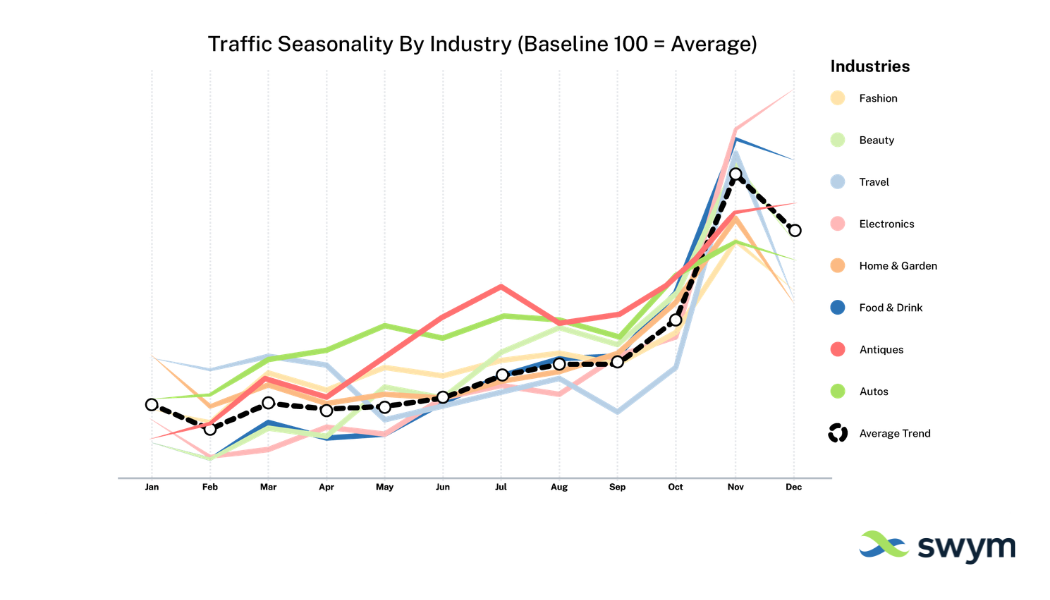
*Monthly users across industries that mirror the global average.
The Fashion and Apparel sector stands out as a clear example of this trend, experiencing a substantial 64% surge in user growth from October to November. This heightened activity is driven by shoppers preparing for cooler weather and the upcoming gifting season. For merchants in this space, November is the critical period where a year's worth of engagement efforts culminate in widespread conversion of high-intent users.
Other categories that exhibit a similar trend include Food & Drinks (64.1%), Travel (58.9%), and Consumer electronics (52%), as well as Beauty, Antiques, and Autos.
Consumer Electronics emerged as the leading category for last-minute purchases, demonstrating a distinct increase in sales directly preceding December.
Seasonality in Other Industries
Now, the data indicates that this rule is not universally applicable across all brands or industries.
Many categories exhibit distinct patterns influenced by specific life events or business cycles:
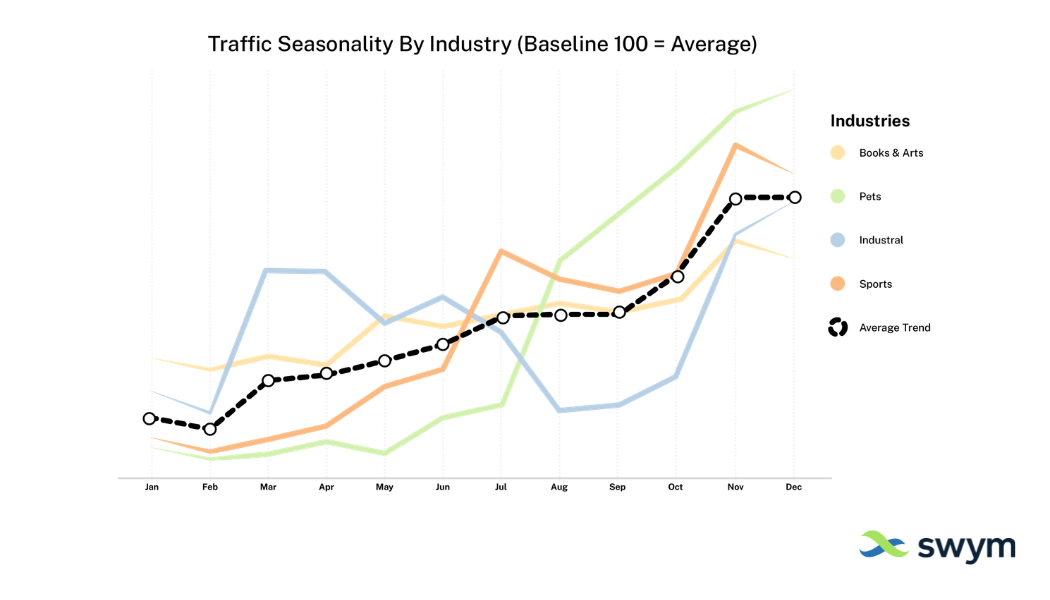
*Monthly users across industries that deviate from the global average.
Business and Industrial brands see high engagement in March and April. This peak corresponds with Q1 budget spending and annual tax seasons. For these B2B merchants, the summer months actually represent their lowest activity period.
Similarly, Books and Arts show consistent demand that builds steadily starting in May. These shoppers are motivated by summer reading lists and back-to-school preparation rather than seasonal discounts.
Sports-Related Items are highly seasonal, with demand surging rapidly and significantly throughout the summer. This trend is closely tied to warmer weather, which encourages outdoor activities, and is also bolstered by major sporting events and a general seasonal focus on fitness and well-being.
Pet owners provide one of the most interesting data points in seasonal planning. While their spending peaks in November, their research and engagement growth begins as early as August. This extended lead-up suggests that pet owners plan their major purchases months in advance. If a brand only starts communicating in November, they have already missed the window where the shopper made their primary decision.
Does Traffic Equal Profit?
While traffic is the foundation, our data suggests that brands should focus on converting more than merely getting traffic as the busiest months of the year don’t always translate into the most profitable.

Q1: The Research Peak
January: Volume drops, and revenue resets, mostly because all the post-holiday gift-giving intentions run out. Still, we see really solid demand conversion in almost every industry.
February: Shoppers show moderate engagement, primarily focused on securing items for the early spring season.
March: It appears that customers are engaging in significant "window shopping," characterized by high levels of engagement and activity without a corresponding readiness to complete a purchase.
Q2 Into the Summer Pulse
April: As seasonal interest peaks, clicks and revenue are starting to show a corresponding relationship.
May: Although volume is rising due to summer planning, conversion rates are not keeping pace. This performance gap is particularly noticeable in categories such as Home & Garden and Books & Arts.
June: Revenue sees a massive spike, indicating a significant rise in efficiency, despite only a modest growth in demand.
Q3: Capturing Intent Before the Noise
July: Demand typically decreases in July due to the priority given to vacations; however, baseline sales remain stable.
When demand is high but revenue is low, you are in the planning phase. If you aren't using wishlists or save-for-later features during this window, you are letting your future revenue evaporate.
August: The return of shoppers to browse for back-to-school and end-of-season items is gradual, only gaining momentum towards the conclusion of the month.
September: Shoppers are beginning to load their wishlists for Q4, resulting in a sharp increase in demand, not so much in conversion.
Q4: The high peak season
October: Early holiday shoppers are converting, driving revenue growth that is outpacing the increase in traffic.
November: Boasts the highest user traffic at the same time it also sees the highest conversion rates across most industries.
December: Revenue remains strong, driven by last-minute purchases and the redemption of gift cards, as shoppers clear their wish lists. This trend persists even when underlying demand is constrained, particularly within categories such as Fashion and Consumer Electronics.
Bridging the Gap with Swym
As we’ve seen, high demand does not always lead to immediate sales.
Success comes from shifting your focus from driving raw traffic to capturing intent.
Swym helps turn high-intent users into customers by capturing their non-purchase signals (such as saving an item to a list) and converting that latent intent into revenue when the time is right.
*The research cited was extracted from an analysis of millions of behavioral interactions and explicit intent signals across our merchant ecosystem.
Capture the Products your Shoppers Truly Love
Swym Wishlist Plus lets shoppers save products they love, ensuring valuable customer intent is never lost and ready to convert.